Handling deposits and partial payments on custom orders
Bespoke tailoring is almost always paid in two goes: a deposit when the order is taken, and the balance when the garment is collected. Your system should remember that split for you, so the amount still owed stays attached to the order and stays correct at every step. Here is how deposits and part payments work for a tailoring shop, using TailorSync as the example.
Take the deposit when you take the order
The deposit you collect while writing up an order is the advance. Record it with the method the customer used (cash, card, bank transfer, UPI, cheque or online), and the order works out where it stands on its own: it reads Paid if the advance covers the whole total, Partial if it covers only some of it, and Unpaid if you took nothing up front. The summary on the order adds up the subtotal, any discount, VAT, the total, the advance and the balance due, so the number the customer owes is clear from the moment the order is saved.
Collect the balance later
When the customer comes to collect, record the rest against the same order. Enter the amount, or tap Full Balance or Half to fill it for you, pick the method and date, and the balance falls accordingly. Clear the balance and the order flips to Paid; cover only part of it and it reads Partial until the next payment.
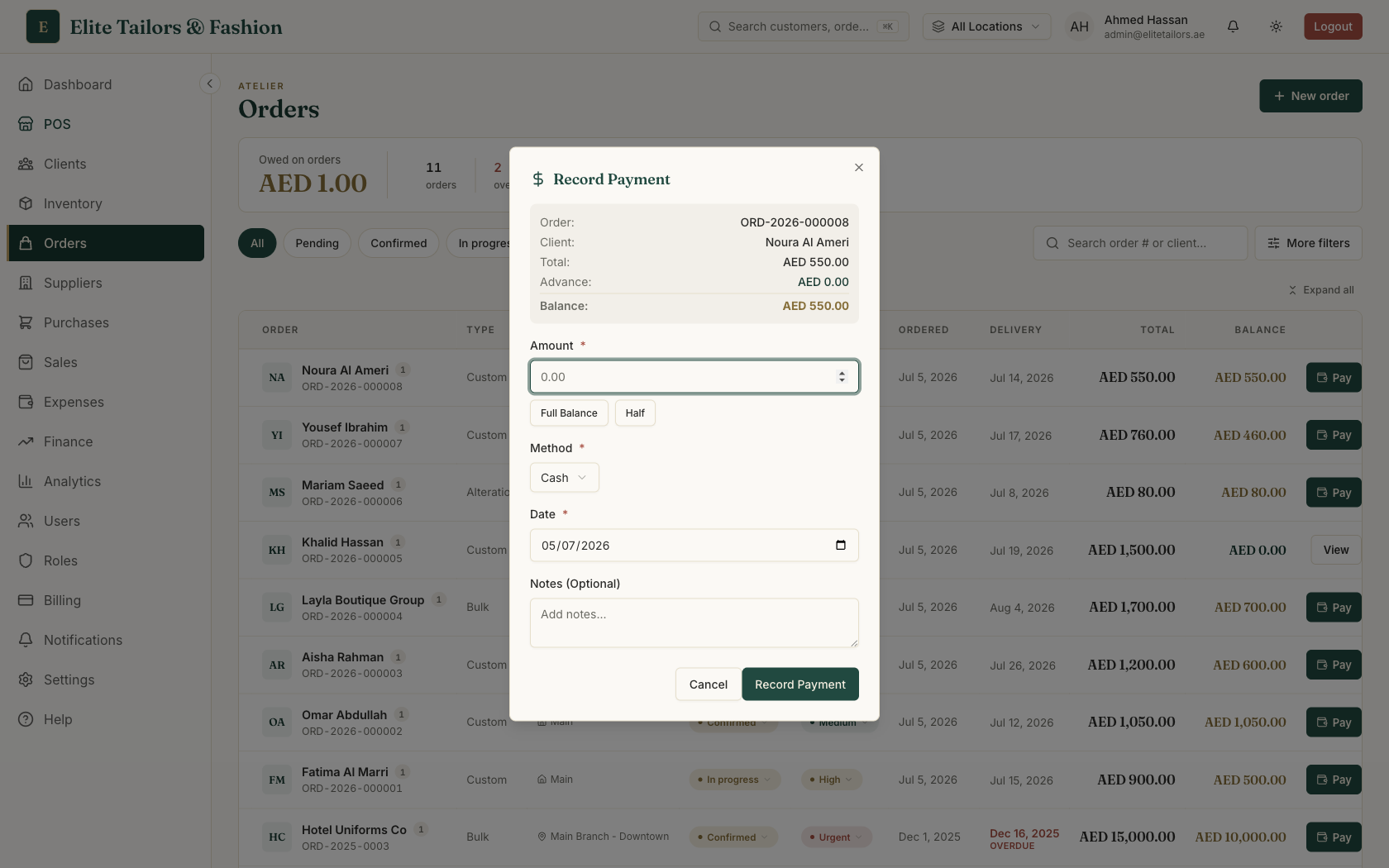
You cannot take more than the balance. TailorSync blocks an overpayment, which keeps a customer account from drifting into a negative balance that someone has to explain later.
Always know what is still owed
Because the balance rides on the order, you never keep it in a separate book. The order's payments view shows the money summary and every payment with its method, date and who recorded it, and the orders list totals the balance owed across all open orders. That total is your answer to the question every owner asks: how much is the workshop waiting to collect.
Deposits at the counter too
The same split works at the point of sale. When a walk-in commissions custom work at the counter, the POS can take a deposit rather than the full amount and track the remaining balance, so a counter deposit and an order advance behave the same way and land in the same books.
Common questions
How do tailoring shops handle deposits on custom orders?
They take a deposit (an advance) when the order is written up and collect the balance on delivery. Recording the advance on the order marks it Paid, Partial or Unpaid automatically and keeps the balance due on the order, so it is visible every time the order is opened.
Can a customer pay for an order in several instalments?
Yes. After the advance, you can record any number of part payments against the order over time. Each one lowers the balance, and the order stays Partial until a payment clears it, at which point it becomes Paid.
What stops staff from recording an overpayment?
TailorSync will not accept a payment larger than the remaining balance, so an order cannot be overpaid. This keeps customer balances accurate and avoids negative balances that have to be reconciled later.
Where can I see what a customer still owes across their orders?
Each order shows its own balance on the payments view, and the orders list totals the balance owed across every open order, so you can see the whole shop's outstanding amount at a glance.
Keep reading